Additional Information
Surgical Technologists are allied health professionals who work under medical supervision to facilitate the safe and effective conduct of invasive surgical procedures. A Surgical Technologist possesses expertise in the theory and application of sterile and aseptic technique and combines the knowledge of human anatomy, surgical procedures, and implementation tools and technologies to facilitate a physician's performance of invasive therapeutic and diagnostic procedures.
Program Goals
The goals of this program are to:
Consistently meet the needs of area employers seeking to hire qualified Surgical Technologists as evidenced by job placement rates.
Provide students with the opportunity to develop the skills and knowledge necessary to gain employment as entry-level surgical technologists and become contributing members of the health care team as evidenced by the NBSTSA National Certification pass rates.
Provide a relevant degree program for Surgical Technologists that includes college-level coursework in management and leadership applicable to a healthcare institution as evidenced by the Surgical Technology Program completion rate.
Admissions Process
Application Deadlines
Application for fall admission is due by May 31 of each year.
Fall Semester Admission Sevier County Campus
- May 31st of the year the student elects to participate in the selection process. (Courses
taken through Spring semester of the year the student elects to participate will be
considered.) Fall acceptance letters will be mailed approximately the last week of
June.
- February 1: Application Period Begins
- May 31: Application Period Ends
Only students who are accepted will be notified by mail.
Surgical Technology Entrance Exam
Additional ranking points can be obtained for either (1) ACT/ACT Residual score of greater than 19, or (2) A defined score on an assessment exam. All tests scores must be less than 5 years old.
The assessment exam currently being used is the HESII-A2. This test consists of three sections including math, reading, and vocabulary. To receive the additional ranking points, the candidate must achieve 80% or better in each of the three sections.
Deadlines for Completion to be considered in the admission ranking
- May 31 - Fall Admission
For information regarding exam scheduling and cost, please visit the Counseling & Testing Website or call 423.585.6800
Admission Requirements
Students intending to apply to the Walters State Community College Surgical Technology program may begin working on the general education courses at any time. All prerequisite program courses must be completed prior to application. The program professional courses must be taken in sequence and are offered only at the Walters State Sevier County Campus except for the clinical courses.
Walters State Community College is supported by state funding and therefore must consider in-state residents before out-of-state residents for acceptance into the Surgical Technology program. Please contact the Office of Admissions for assistance in determining Tennessee residency.
The Surgical Technology program adheres to the core performance standards adopted by the Tennessee Board of Regents. Admission to and progression in the Surgical Technology program is not based on these standards but should be used to assist the student in determining whether accommodations or modifications are necessary. The standards are:
- Critical thinking ability sufficient for clinical judgment;
- Interpersonal abilities sufficient to effectively interact with individuals, families,
and
groups from a variety of social, emotional, cultural, and intellectual backgrounds; - Communication abilities sufficient for interaction with others in verbal and written
form; - Physical abilities sufficient to move from room to room and maneuver in small
spaces; - Gross and fine motor abilities sufficient to provide safe and effective surgical care;
- Auditory abilities sufficient to monitor and assess surgical needs;
- Visual ability sufficient for observation and assessment necessary in surgical care;
- Tactile ability sufficient for physical assessment.
If a student believes that one of more of the standards cannot be met without accommodation or modification, the Surgical Technology program will determine whether or not accommodations or modification can be reasonably made. A student should contact the Director of Surgical Technology for assistance.
Eligibility Criteria for Admission
- Have an overall minimum GPA of 2.0;
- Have official copies of previous college transcripts sent to WSCC Admissions Office;
- Attach an unofficial copy of your college transcripts to the application.
Selection Criteria
These items are the areas in which students are awarded program application ranking points.
- Grades 1st received in program BIOL courses
(Students who complete BIOL 2010/11 and 2020/21 prior to program admission increase their chances of academic and clinical success in the Surgical Technology program.) - Students who are enrolled in BIOL 2010/2011 and BIOL 2020/2021 for summer term will be given consideration, with possible conditional admission into the Surgical Technology program pending final summer grades.
- Designated Admission Exam: ACT 19 or > or HESII-A2 > 80% on all sections. Admission exams must have been completed within the last 5years;
- Overall GPA in all required general education and prerequisite courses;
- Completion of all general education requirements;
- Qualified applicants will be contacted by phone to schedule an interview.
CLINICAL SITE PLACEMENT
- In order to prepare students for the current health care system, students will be
offered a variety of clinical experiences. Arrangements for clinical placement of
students will be made by the Clinical Coordinator/Program Director in collaboration
with clinical facilities.
- Students are expected to provide their own transportation to clinical facilities.
Although carpooling is encouraged, it is not possible to arrange student clinical
schedules to accommodate established carpool arrangements.
- The recommendation is for students to NOT work the immediate 8 hours prior to clinical
experience.
- Clinical agencies are not liable for injuries a student may sustain, or for the diagnosis
or treatment of any illness a student may contract while in the agency for clinical
experiences. Neither WSCC Surgical Technology Program nor the clinical agencies are
liable for injuries sustained by students. Students are required to carry health insurance.
Students are not considered as employees of the clinical agencies during the times
assigned for clinical experiences.
- Criminal Background checks may be a requirement for training at some affiliated clinical
sites.* Based on the results of these checks, an affiliated clinical site may determine
to not allow your presence at a facility. Additionally, a criminal background may
preclude licensure or employment. If you are assigned to a clinical affiliate requiring
a criminal background check, you will be required to provide the requested information.
Acceptance of you as a student in the clinical facility will be at the clinical affiliate’s
discretion. As a student, you will be responsible for the cost of any required background
checks.
- If a clinical denies your presence in the facility, you will not be able to complete
the clinical experience and you will be withdrawn from the program.
All students are required to notify the Dean of the Health Programs Division at any time any criminal charges or convictions occur within 5 days of their occurrence as it may impact practice.
The specifications for the background check are at the discretion of the clinical affiliate. Should the affiliate not require a specific vendor for the check, the program director will provide a list of available vendors to purchase the required criminal background check. The cost of the criminal background check will average $50.00-$100.00. The exact amount may vary based on the affiliate specifications and individual student differences. As a student you will not be allowed access to a clinical facility for any student experience until the clinical facility has authorized your presence.
* Students will be given further instructions at course orientation.
Please see consent forms in Appendix G. - Drug Screen – Students will be required to complete a drug screen. This will be at
the student’s expense.
- WSCC or the clinical affiliates are not responsible for the loss of student property
at the clinical site.
Students should leave valuables at home and bring only the amount of cash needed.
Estimated Expenses
Tuition, Fees and Financial Aid
Tuition is set each June by the Tennessee Board of Regents. Tuition and fees for the current academic year may be viewed on the Cashiers Office website.
All tuition and fees are subject to change by the Tennessee Board of Regents.
*A Specialized Allied Health Science Fee of $25 per credit hour will be applied to all Allied Health Science courses. See Tuition and Fees link above.
** Program courses taken in an online format are subject to a distance education fee.
Books, Supplies and Additional Program Expenses
- Books
Visit Walters State Bookstore for book titles and prices - Supplies
Uniforms, clinical and lab supplies - Liability Insurance
Physical examination and immunizations - CPR certification
Criminal background check/Drug screening - Credentialing Requirements
Four types of financial aid are available; federal, state, institutional and other sources. Students need to send FAFSA information to the college for consideration for state and/or federal money (lottery scholarships, Pell grants, etc.). WSCC is an eligible institution for Hope (lottery) scholarships. For specific information please contact the Financial Aid Office.
Occupational Hazards
Frequently Asked Questions
- Location
- Graduate Competencies
- Clinical Case Requirements
- Career Information
- What should I do if I do not receive notification?
Location
Graduate Competencies
Upon program completion, the graduate will be able to:
- Correlate the knowledge of anatomy, physiology, pathophysiology, and microbiology to their role as a Surgical Technologist.
- Demonstrate a safe and professional level of practice and knowledge in their role as a Surgical Technologist.
- Acquire an understanding of the ethical, legal, moral, and medical values related to the patient and the surgical team during the perioperative experience.
- Correlate the elements, action, and use of medications and anesthetic agents used during the perioperative experience.
- Implement safe practice techniques in regards to perioperative routines, patient transportation, positioning, and emergency procedures.
- Integrate principles of surgical asepsis as part of the perioperative experience.
- Accurately apply knowledge and skills of a professional Surgical Technologist to address the biopsychosocial needs of the surgical patient.
- Perform proficiently and competently as an entry-level surgical technologist in the cognitive, psychomotor, and affective learning domains.
- Value the professional attributes of the Surgical Technologist.
Clinical Case Requirements
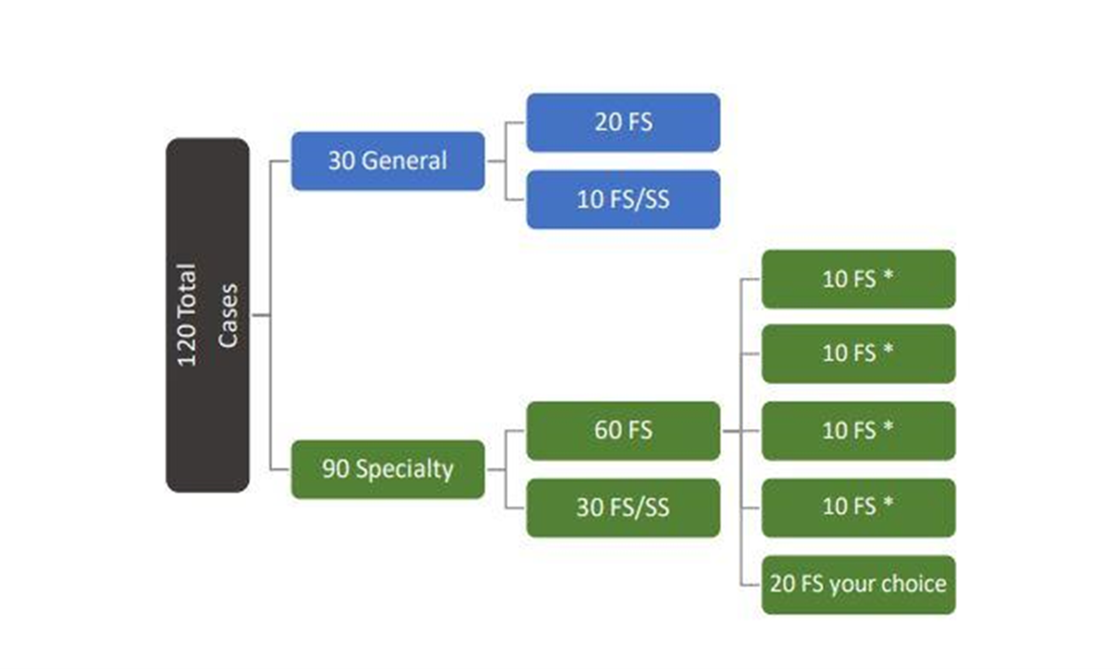
Students must complete a minimum of 120 cases as delineated below.
A. General Surgery cases
- Students must complete a minimum of 30 cases in General Surgery;
- 20 which must be performed in the First Scrub Role (FS).
- The remaining 10 cases may be performed in either the First or Second Scrub Role (SS).
B. Specialty cases
- Students must complete a minimum of 90 cases in various surgical specialties, excluding
General Surgery;
- A minimum of 60 which must be performed in the First Scrub Role (FS) and evenly distributed
between a minimum of four surgical specialties.
- A minimum of ten cases in four different specialties must be completed in the FS role (40 cases total).
- The additional 20 cases in the FS role may be distributed amongst one surgical specialty or multiple surgical specialties.
- The remaining 30 cases may be performed in any surgical specialty in either the FS or SS role.
- A minimum of 60 which must be performed in the First Scrub Role (FS) and evenly distributed
between a minimum of four surgical specialties.
- Surgical specialties (excluding General Surgery)
- Cardiothoracic
- Genitourinary
- Neurologic
- Obstetric and Gynecologic
- Orthopedic
- Otorhinolaryngologic
- Ophthalmologic
- Oral Maxillofacial
- Peripheral vascular
- Plastic and reconstructive
- Procurement and transplant
C. Diagnostic vs operative endoscopy cases.
- An endoscopy classified as a semi-critical procedure is considered a diagnostic case.
- An endoscopy classified as a critical procedure is considered an operative case.
- Diagnostic and operative cases will be counted according to specialty.
- Diagnostic cases are counted in the SS role up to a total of ten of the required 120
cases.
- A cystoscopy is a diagnostic procedure. If an adjunct procedure is performed, it is considered operative; therefore, a cystoscopy with ureteral stent placement is an operative procedure.
- Vaginal delivery cases are counted in the SS role of the OB/GYN specialty up to a total of five of the required 120.
D. Documentation
- Case performed
- Role performed
- Performance evaluations
- Verification by program director
- The surgical technology program is required to verify through the surgical rotation documentation the students’ progression in the scrub role in surgical procedures of increased complexity as he/she moves towards entry-level graduate competency.
Career Information
Salary and Job Outlook
The program will increase the number of surgical technologist employees to meet the over 12% increase expected for the 2016-2026 period of time as noted on the Bureau of Labor Statistics May 2017 Job Outlook Data. Surgical technology is considered a high skill-high wage allied health profession and data from the State of Tennessee notes a need for 2970 surgical technologists in the state by 2017. The median annual salary for Tennessee surgical technologists is projected in the range of $43,310.
Work Settings
Surgical Technologists are allied health professionals who work under medical supervision to facilitate the safe and effective conduct of invasive surgical procedures at a hospital. A Surgical Technologist possesses expertise in the theory and application of sterile and aseptic technique and combines the knowledge of human anatomy, surgical procedures, and implementation tools and technologies to facilitate a physician's performance of invasive therapeutic and diagnostic procedures.
Work Policy
The clinical component of the program shall be educational in nature. The student shall not be substituted for personnel during the clinical component of the program. Each student will be assigned a preceptor to direct and teach in the clinical setting.
What should I do if I do not receive notification?
If you know you are qualified
- a grade of C or better in BIOL 2010/2011 and BIOL 2020/2021
- completed computer competency
- grade point average of at least 2.0 excluding developmental courses
- completed all required developmental courses
Your name is most likely on an alternate list. If space becomes available, you will be notified by the first day of class of the semester.
If you think you might not have been qualified
Please contact a health program advisor to assist you in planning your course work to increase your chance of success next year.
Advisors are available Monday thru Friday 8:30 a.m.-4:00 p.m.
Please call 865.286.2783 to schedule an appointment
If you were qualified but not accepted
You will need to reapply for the next admission period.
- It is the student's responsibility to make sure transcripts are forwarded from transferring institutions to WSCC Admissions Department promptly.
- Only completed applications will be considered for admission.
